GtoPdb is requesting financial support from commercial users. Please see our sustainability page for more information.
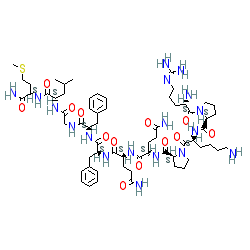
substance P 
GtoPdb Ligand ID: 2098
|
Abbreviated name: SP
Compound class:
Endogenous peptide in human, mouse or rat
Comment: Substance P is a vasoactive neuropeptide that is involved in trigeminovascular signalling, and is implicated in inducing pain and inflammation [3]. It has been proposed to trigger migraine pathophysiology [1,9].
Species: Human, Mouse, Rat

Ligand Activity Visualisation ChartsThese are box plot that provide a unique visualisation, summarising all the activity data for a ligand taken from ChEMBL and GtoPdb across multiple targets and species. Click on a plot to see the median, interquartile range, low and high data points. A value of zero indicates that no data are available. A separate chart is created for each target, and where possible the algorithm tries to merge ChEMBL and GtoPdb targets by matching them on name and UniProt accession, for each available species. However, please note that inconsistency in naming of targets may lead to data for the same target being reported across multiple charts. ✖
View more information in the IUPHAR Pharmacology Education Project: substance p |
|
|||||||||||||||||
| References |
|
1. Al-Khazali HM, Christensen RH, Gozalov E, Hakimzadeh Z, Melchior AG, Dominguez-Moreno R, Ashina M, Ashina H. (2025)
Effects of substance P on headache induction and arterial dilation in healthy adults. Cephalalgia, 45 (5): 3331024251336132. [PMID:40369974] |
|
2. Al-Khazali HM, Christensen RH, Melchior AG, Al-Khazali S, Chaudhry BA, Ashina M, Ashina H. (2026)
Substance P Triggers Migraine Attacks without Aura: A Randomised, Double-Blind, Placebo-Controlled, Two-Way Crossover Human Experimental Study. The Lancet, Preprint. DOI: 10.2139/ssrn.6168149 |
|
3. Alpay B, Christensen RH, Al-Khazali HM, Ashina M, Ashina H. (2025)
Substance P and the trigeminovascular system: From preclinical mechanisms to human headache induction. Cephalalgia, 45 (8): 3331024251355944. [PMID:40746227] |
|
4. Bellucci F, Carini F, Catalani C, Cucchi P, Lecci A, Meini S, Patacchini R, Quartara L, Ricci R, Tramontana M et al.. (2002)
Pharmacological profile of the novel mammalian tachykinin, hemokinin 1. Br J Pharmacol, 135 (1): 266-74. [PMID:11786503] |
|
5. Bennacef I, Tymciu S, Dhilly M, Lasne MC, Debruyne D, Perrio C, Barré L. (2004)
Synthesis and biological evaluation of novel fluoro and iodo quinoline carboxamides as potential ligands of NK-3 receptors for in vivo imaging studies. Bioorg Med Chem, 12 (16): 4533-41. [PMID:15265501] |
|
6. Emonds-Alt X, Golliot F, Pointeau P, Le Fur G, Breliere JC. (1993)
Characterization of the binding sites of [3H]SR 48968, a potent nonpeptide radioligand antagonist of the neurokinin-2 receptor. Biochem Biophys Res Commun, 191 (3): 1172-7. [PMID:7682062] |
|
7. Lansu K, Karpiak J, Liu J, Huang XP, McCorvy JD, Kroeze WK, Che T, Nagase H, Carroll FI, Jin J et al.. (2017)
In silico design of novel probes for the atypical opioid receptor MRGPRX2. Nat Chem Biol, 13 (5): 529-536. [PMID:28288109] |
|
8. McNeil BD, Pundir P, Meeker S, Han L, Undem BJ, Kulka M, Dong X. (2015)
Identification of a mast-cell-specific receptor crucial for pseudo-allergic drug reactions. Nature, 519 (7542): 237-41. [PMID:25517090] |
|
9. Pellesi L, Edvinsson L. (2025)
Revisiting substance P in migraine: a methodological approach inspired by anti-CGRP and anti-PACAP success. J Headache Pain, 26 (1): 22. [PMID:39891050] |
|
10. Sarau HM, Feild JA, Ames RS, Foley JJ, Nuthulaganti P, Schmidt DB, Buckley PT, Elshourbagy NA, Brawner ME, Luttmann MA et al.. (2001)
Molecular and pharmacological characterization of the murine tachykinin NK(3) receptor. Eur J Pharmacol, 413 (2-3): 143-50. [PMID:11226387] |
|
11. Sarau HM, Griswold DE, Potts W, Foley JJ, Schmidt DB, Webb EF, Martin LD, Brawner ME, Elshourbagy NA, Medhurst AD et al.. (1997)
Nonpeptide tachykinin receptor antagonists: I. Pharmacological and pharmacokinetic characterization of SB 223412, a novel, potent and selective neurokinin-3 receptor antagonist. J Pharmacol Exp Ther, 281 (3): 1303-11. [PMID:9190866] |



 This work is licensed under a Creative Commons Attribution-ShareAlike 4.0 International License