GtoPdb is requesting financial support from commercial users. Please see our sustainability page for more information.
APT-101 
GtoPdb Ligand ID: 14335
|
Synonyms: APT101 | compound 423 [WO2017100558A1] | compound 52 [PMID: 35594649]
Compound class:
Synthetic organic
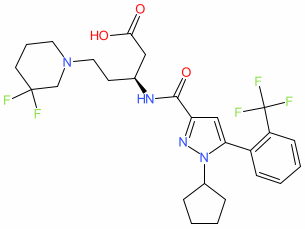
Comment: APT-101 (APIE Therapeutics) is an orally bioavailable small molecule that acts as an apelin receptor (APLNR; APJ) agonist [2]. It activates the apelin/apelin receptor pathway to trigger the repair of pulmonary vascular endothelial cell breakdown that drives damage in fibrotic and sclerotic lung diseases [3,5-8].
We obtained the IUPAC descriptor for the molecule from the FDA Orphan Drug register. This chemical structure was first claimed in a patent series from RTI International [4], and is a structure match for compound 52 in [2]. |
|
|||||||||||||||||||||||||||||||||||

| References |
|
1. FDA.
Search Orphan Drug Designations and Approvals. Accessed on 22/01/2026. Modified on 22/01/2026. fda.gov, www.accessdata.fda.gov/scripts/opdlisting/oopd/detailedIndex.cfm?cfgridkey=865821 |
|
2. Narayanan S, Dai D, Vyas Devambatla RK, Albert V, Bruneau-Latour N, Vasukuttan V, Ciblat S, Rehder K, Runyon SP, Maitra R. (2022)
Synthesis and characterization of an orally bioavailable small molecule agonist of the apelin receptor. Bioorg Med Chem, 66: 116789. [PMID:35594649] |
|
3. Niemczyk A, Waśkiel-Burnat A, Zaremba M, Czuwara J, Rudnicka L. (2023)
The profile of adipokines associated with fibrosis and impaired microcirculation in systemic sclerosis. Adv Med Sci, 68 (2): 298-305. [PMID:37696138] |
|
4. Runyon SP, Maitra R, Narayanan S, Thomas JB, Rehder KSm Olepu S. (2017)
Improved apelin receptor (apj) agonists and uses thereof. Patent number: WO2017100558A1. Assignee: RTI International Inc. Priority date: 09/12/2016. Publication date: 15/06/2017. |
|
5. Selman M, Pardo A. (2006)
Role of epithelial cells in idiopathic pulmonary fibrosis: from innocent targets to serial killers. Proc Am Thorac Soc, 3 (4): 364-72. [PMID:16738202] |
|
6. Shi N, Wang Y, Xia Z, Zhang J, Jia S, Jiao Y, Wang C, Wang X, Zhao J, Zhang J et al.. (2024)
The regulatory role of the apelin/APJ axis in scarring: Identification of upstream and downstream mechanisms. Biochim Biophys Acta Mol Basis Dis, 1870 (4): 167125. [PMID:38508477] |
|
7. Wang H, Cong L, Yin X, Zhang N, Zhu M, Sun T, Fan J, Xue F, Fan X, Gong Y. (2022)
The Apelin-APJ axis alleviates LPS-induced pulmonary fibrosis and endothelial mesenchymal transformation in mice by promoting Angiotensin-Converting Enzyme 2. Cell Signal, 98: 110418. [PMID:35882286] |
|
8. Zielinski M, Chwalba A, Jastrzebski D, Ziora D. (2023)
Adipokines in interstitial lung diseases. Respir Physiol Neurobiol, 315: 104109. [PMID:37393966] |



 This work is licensed under a Creative Commons Attribution-ShareAlike 4.0 International License