GtoPdb is requesting financial support from commercial users. Please see our sustainability page for more information.
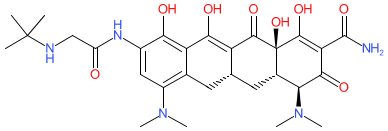
tigecycline 
GtoPdb Ligand ID: 10929
|
Synonyms: GAR-936 | GAR936 | TBG-MINO | Tygacil® | WAY-GAR-936

tigecycline is an approved drug (FDA (2005), EMA & UK (2006))
Compound class:
Synthetic organic
Comment: Tigecycline is a first-in-class glycylcycline (tetracycline) antibacterial derived from minocycline [5,7]. It was designed to overcome efflux and ribosomal protection mechanisms of resistance that have emerged against the tetracycline class of compounds.
|
|
|||||||||||||||||||||||||||||||||||

| No information available. |
Summary of Clinical Use  |
| Tigecycline is administered by intravenous infusion. In the UK, it is indicated for the treatment of complicated skin and soft tissue infections (but NOT diabetic foot infections) and complicated intra-abdominal infections. Its use should be restricted for infections for which other antibacterials are not suitable. Tigecycline was removed from the World Health Organization's List of Essential Medicines in 2019, as it did not meet the revised criteria for inclusion on the Model Lists as a Reserve group agent [8]. |
| Mechanism Of Action and Pharmacodynamic Effects |
| Tigecycline inhibits bacterial protein synthesis by binding reversibly to the bacterial 30S ribosomal subunit and preventing the aminoacyl tRNA from binding to the acceptor (A) site on the mRNA-ribosome complex (reviewed in [6]). The glycylcyclines and tetracyclines share a common binding site on the ribosome, with glycylcyclines exhibiting stronger binding [1]. |
| External links |
|
For extended ADME data see the following: Electronic Medicines Compendium (eMC) Drugs.com European Medicines Agency (EMA) |



 This work is licensed under a Creative Commons Attribution-ShareAlike 4.0 International License