From August 18th 2026, GtoPdb will require users to register to use the website. Please see our blog post for more information.
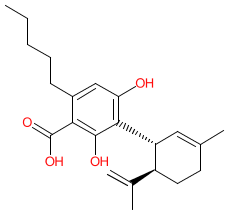
cannabidiolic acid 
GtoPdb Ligand ID: 10600
|
Synonyms: cannabidiol acid [1] | CBDA
Compound class:
Synthetic organic
Comment: Cannabidiolic acid (CBDA) is a phytocannabinoid that is present at a significant concentration in Cannabis sativa [3]. It slowly decarboxylates to cannabidiol within the plant tissue. The decarboxylation process is accelerated by heat. To overcome its inherent instability, the more stable analogue cannabidiolic acid methyl ester (HU-580) was synthesised [4]. In in vivo models CBDA has been shown to produce anti-nausea [2,6-7] and anxiolytic‐like effects [5].

Ligand Activity Visualisation ChartsThese are box plot that provide a unique visualisation, summarising all the activity data for a ligand taken from ChEMBL and GtoPdb across multiple targets and species. Click on a plot to see the median, interquartile range, low and high data points. A value of zero indicates that no data are available. A separate chart is created for each target, and where possible the algorithm tries to merge ChEMBL and GtoPdb targets by matching them on name and UniProt accession, for each available species. However, please note that inconsistency in naming of targets may lead to data for the same target being reported across multiple charts. ✖ |
|
|||||||||||||||||||||||||||||||||||
| References |
|
1. Baraldi PG, Preti D, Materazzi S, Geppetti P. (2010)
Transient receptor potential ankyrin 1 (TRPA1) channel as emerging target for novel analgesics and anti-inflammatory agents. J Med Chem, 53 (14): 5085-107. [PMID:20356305] |
|
2. Bolognini D, Rock EM, Cluny NL, Cascio MG, Limebeer CL, Duncan M, Stott CG, Javid FA, Parker LA, Pertwee RG. (2013)
Cannabidiolic acid prevents vomiting in Suncus murinus and nausea-induced behaviour in rats by enhancing 5-HT1A receptor activation. Br J Pharmacol, 168 (6): 1456-70. [PMID:23121618] |
|
3. Mechoulam R, Gaoni Y. (1965)
Hashish. IV. The isolation and structure of cannabinolic cannabidiolic and cannabigerolic acids. Tetrahedron, 21 (5): 1223-9. [PMID:5879350] |
|
4. Pertwee RG, Rock EM, Guenther K, Limebeer CL, Stevenson LA, Haj C, Smoum R, Parker LA, Mechoulam R. (2018)
Cannabidiolic acid methyl ester, a stable synthetic analogue of cannabidiolic acid, can produce 5-HT1A receptor-mediated suppression of nausea and anxiety in rats. Br J Pharmacol, 175 (1): 100-112. [PMID:29057454] |
|
5. Rock EM, Limebeer CL, Petrie GN, Williams LA, Mechoulam R, Parker LA. (2017)
Effect of prior foot shock stress and Δ9-tetrahydrocannabinol, cannabidiolic acid, and cannabidiol on anxiety-like responding in the light-dark emergence test in rats. Psychopharmacology (Berl.), 234 (14): 2207-2217. [PMID:28424834] |
|
6. Rock EM, Parker LA. (2013)
Effect of low doses of cannabidiolic acid and ondansetron on LiCl-induced conditioned gaping (a model of nausea-induced behaviour) in rats. Br J Pharmacol, 169 (3): 685-92. [PMID:23488964] |
|
7. Rock EM, Parker LA. (2015)
Synergy between cannabidiol, cannabidiolic acid, and Δ⁹-tetrahydrocannabinol in the regulation of emesis in the Suncus murinus (house musk shrew). Behav Neurosci, 129 (3): 368-70. [PMID:26030435] |



 This work is licensed under a Creative Commons Attribution-ShareAlike 4.0 International License